![]() |
![]() |
![]() |
![]() |
| Hunting Home | Contact Us | News | DNR Home | ![]() |
|
|
| Wildlife Diversity |
| Fishing |
| Law Enforcement |
| Publications |
| Disability Services |
| News/Info |
| Licensing |
| go Wild! |
| License Plate |
| Kid Zone |
Deer Control In Home Gardens
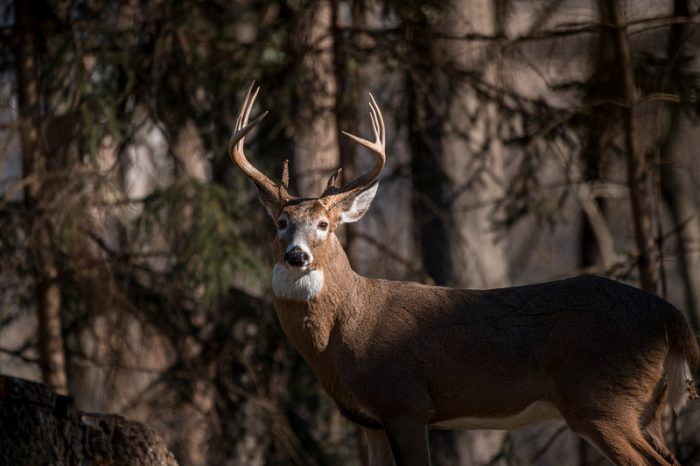
Deer damage to home gardens and shrubs is the number one complaint in urban and rural landscapes. Using an
integrated approach of repelling and/or restricting deer access is the most effective method to reducing damage. Deer damage
permits are available to rural landowners, however, urban landowners must rely on other methods to reduce damage.Repellents Repellents discourage deer feeding by having either an offensive taste or odor. No repellent is continuously effective, and what works in one location may be useless for another location. Factors which contribute to this variability are deer feeding habits and environmental conditions. Repellent application can be costly and labor intensive. Making the right decision about the use of repellents involves weighing the costs against the benefits. Generally it has been found that repellents are most cost-effective where the following conditions exists:
There is a broad choice of repellents - human hair, soap, feathermeal, bloodmeal, creosote, mothballs, tankage and commercial chemical repellents. The greatest amount of protection for home gardens with repellents is obtained by using several different repellents and rotating their use. Application Proper use of repellents is critical in providing protection. You must learn to carefully monitor deer activity so that applications are properly timed. It is much easier to prevent damage than it is to stop it after it is underway. Repellents should be applied before damage is likely to occur and before deer become accustomed to feeding on the crop. Commercial repellents must always be applied according to the manufacturer's directions. Other essentials for success with the use of repellents are as follows:
Contact the WVU County Extension Office and your local chemical suppliers for the most current information on available repellents. As with all chemicals, read the label carefully for specific information on crops, rates, and application methods. Costs can be further reduced by adding the repellent to a regular pesticide spray, if permitted in the label directions. The following home remedies (Table 1) and commercial chemicals (Table 2) repel deer. Table 1. Noncommercial Deer Repellents (Home Remedies)
Table 2. Commercial Deer Repellents (Follow Manufacturer Labels)
Fences Fencing your garden against deer can be accomplished in a number of ways. However, the seriousness of your deer problem and the amount of money you are willing to spend will directly effect your choice of design and materials. Modifications can be made to the fence to exclude other wildlife as well, such as rabbits, raccoons and groundhogs. In areas where deer populations are low a single wire electric fence, 30 inches off the ground, can deter the deer from your garden (Figure 1). As deer populations increase, or entry through the single wire is apparent, additional wires should be added. Deer normally will attempt to go under or through a fence rather than jump over it, therefore, a vertical two wire electric fence should have wires located at 15 inches and 30 inches off the ground. If three wires are used, place the wires at 10, 20 and 30 inches off the ground. Small animals can be stopped by adding wires at 3 and 6 inches off the ground. The installation of screen door springs at fence corners will prevent deer from breaking the wire. Another electric fence that has proven effective is a two dimensional design. A single wire at 50 inches is placed around the garden. A second set of two wires is located 38 inches outside the first wire at the heights of 15 and 43 inches. Fences of these designs, vertical and two dimensional, can be erected by using hand driven posts and poly-wire electric fence. This makes it possible to take the fence down and put it back up several times. Spacing between posts should not exceed 30 feet. Fence posts may be wooden, metal, or fiberglass. If wood or metal posts are used, insulators are required. If fiberglass posts are used the posts serve as the insulator. The key to effective fences is a high voltage, low impedance charger, and a good ground rod. High voltage chargers require less vegetative maintenance. A good ground is an absolute requirement. A 6 - 8 foot ground rod will generally provide sufficient grounding even during dry weather. High voltage chargers are available in several different types: solar, AC plug-in, DC wet or dry cell battery, or six 1.5 volt flashlight batteries. These chargers generate approximately 5,000 volts of low amperage electricity and do an excellent job of repelling wildlife. Prices of chargers vary considerably, so it is important to check around before purchasing one. For safety, lightweight signs should be attached to the fence alerting people to the fact that the fence is electric. Permanent, taller fences will provide more deer protection; however, they are more expensive. Permanent deer fences which have proven successful are the high tensile electric, 6-wire vertical fence, and the 8 foot high woven wire non-electric fence. Important points to remember in constructing an electric fence around a garden:
A garden of up to 8,000 square feet can be fenced with a temporary, electric deer fence for a reasonable cost. If properly maintained the fence can be used for several years with the only added cost being batteries. If wildlife damage has been a problem in your garden, an electric fence might soon pay for itself. Figure 1. Fence Designs for Repelling Deer
Although chemical repellents are designed to have no worse effect on animals than leaving a bad taste in their mouths, a word of caution is necessary. Never use more often, or in greater volume, than the label recommends. Chemical repellents are classified as pesticides, and your state pesticide regulating agency or extension service can usually give you pointers on their proper use and storage. Trade and brand names are used only for the purpose of information and the Cooperative Extension Service of West Virginia University and the WV .Division of Natural Resources do not guarantee nor warrant the standard of the product, nor do they imply approval of the product to the exclusion of others which may also be suitable. No advertisement is intended nor implied. Unforseen and unpredictable changes made by the Environmental
Protection Agency affecting names, tolerances, and uses of pesticides may occur
between the time this publication was prepared and the time it is in your hands.
The information herein is believed to be correct at the time of publication and
is offered for purposes of general guidance only. References Harris, M.T., W.L. Palmer, and J.L. George. 1983. Preliminary screening of white-tailed deer repellents. J. Wildl. Manage. 47 (2):517-519. McAninch, J.B., M.R. Ellingwood, and R.S. Winchcombe. 1983. Deer damage control in New York agriculture. NY State Dept. of Agric. And Markets. 13 pp. Authors Richard L. Hall, Robert W. Cheves, Jr., Tara A. Baugher, Steven M. Carcaterra, W. Randolph Davidson, William N. Grafton, Thomas R. McConnell, Arthur W. Selders, Charles E. Williams, David J. Workman. Appreciation is extended to Michael J. Kridle. |
||||||||||||||||||||||||||||||||||||||||||||||||||||||
|
HOT TOPICS... |
|||||||
|---|---|---|---|---|---|---|---|
|
Trout Stocking |
Wildlife Viewing |
Licenses/Permits |
| Fishing Waters | Park Regulations | |
|||||||
|
Contact Webmaster
|
dnr.wildlife@wv.gov © 2003 West Virginia Division of Natural Resources |
|||||||